Currently Empty: £0.00

Call Us:
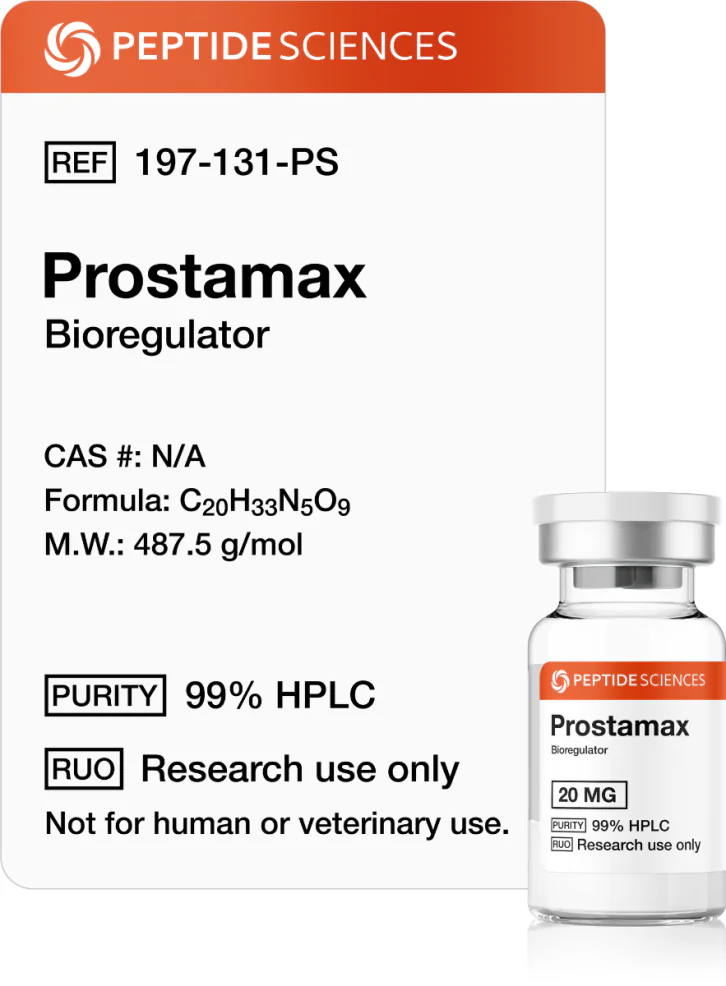



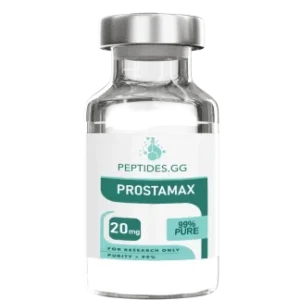
Prostamax 20mg represents a fundamentally different approach to prostate health—not through hormone suppression or symptom masking, but through epigenetic regulation at the cellular level.

Price range: £38.00 through £235.00
Prostamax 20mg is a synthetic tetrapeptide bioregulator with the amino acid sequence Lysine-Glutamic Acid-Aspartic Acid-Proline (Lys-Glu-Asp-Pro, abbreviated KEDP) . It has a molecular formula of C₂₀H₃₃N₅O₉ and a molecular weight of 487.50 g/mol .

It belongs to the Khavinson family of “short-peptide bioregulators”—a class of 2–4 amino acid peptides proposed to function as tissue-specific gene regulators . Within this framework, each organ has its own short-peptide bioregulator: Epitalon (AEDG) for the pineal gland, Pinealon (EDR) for neuronal tissue, and Prostamax (KEDP) for the prostate .
Prostamax is a linear synthetic tetrapeptide with a free N-terminal amine on lysine and a free C-terminal carboxylate on proline, with two acidic side chains (glutamic acid and aspartic acid) and one basic side chain (lysine) . This specific charge distribution influences how the peptide interacts with cells and their nuclear components . Proline’s unique cyclic structure creates spatial constraints that affect the peptide’s three-dimensional shape .
The molecular weight of 487.5 g/mol places Prostamax in the small tetrapeptide range, allowing it to cross cellular barriers and reach intracellular targets that larger molecules cannot access . The peptide’s small size makes synthesis straightforward and economically practical compared to larger proteins .
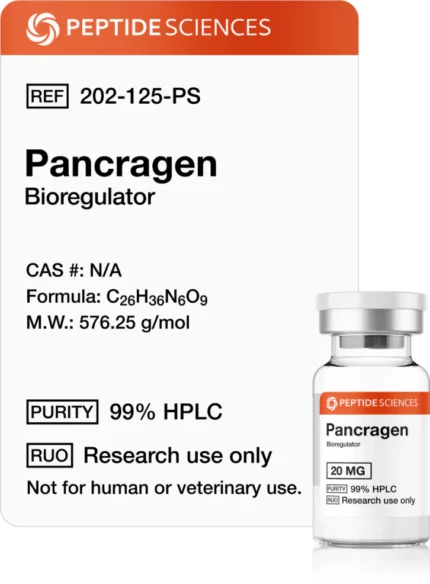
Prostamax shares the Lys-Glu-Asp (KED) core sequence with several other Khavinson peptides: Pancragen (KEDW) and Livagen (KEDA) differ only in their C-terminal amino acid . This structural similarity, combined with distinct tissue-targeting properties, illustrates the Khavinson group’s hypothesis that the C-terminal residue determines tissue specificity while the shared KED core provides common epigenetic regulatory activity .
Epigenetic Modulation of Gene Expression
It is proposed to act through the general mechanism described for Khavinson’s peptide bioregulators: selective interaction with DNA and chromatin structures in target tissue cells, leading to modulation of gene expression . The peptide complex is thought to bind complementary DNA sequences in prostate cell chromatin, influencing transcription of genes involved in cell proliferation, apoptosis, and inflammatory signaling .
Chromatin Decondensation
The primary characterized mechanism is its effect on chromatin structure—particularly in cells from elderly individuals . In a 2004 study comparing five Khavinson peptides in leukocytes from subjects aged 75–88 years, all five peptides induced activation of ribosome genes, decondensation of densely packed chromatin fibrils, and release of genes repressed by age-specific condensation of euchromatic regions . Specifically, treatment with Prostamax led to decondensation of chromosome 1 pericentromeric structural chromatin .
Within the Khavinson interpretation, this is offered as evidence that KEDP can “switch on” age-suppressed gene-expression states. The peptide may facilitate a relaxation of chromatin structure, transitioning from a condensed 30-nanometer fiber to a more relaxed 10-nanometer filament, potentially supporting gene accessibility and modulating gene expression patterns .
Anti-Inflammatory Activity
Research has demonstrated anti-inflammatory activity in rat prostatitis models, including reduction of tissue swelling and vascular congestion . Intramuscular KEDP reduced inflammatory markers in preclinical models of chronic prostatitis .
Stimulation of Reparative Processes
It has been shown to stimulate reparative processes in prostatic organotypic tissue cultures. The peptide complex is hypothesized to carry tissue-specific regulatory information that can normalize gene expression in aging or damaged prostate cells . The bioregulatory effect is thought to normalize the balance between epithelial proliferation and apoptosis that becomes disrupted during BPH development .
Benign Prostatic Hyperplasia (BPH)
BPH is a condition affecting the majority of aging men, characterized by prostate enlargement that can cause urinary symptoms including frequent urination, urgency, and weak urine flow . Preclinical studies have examined Prostamax’s ability to restore functional parameters of prostate tissue, reduce inflammatory markers, and normalize proliferative activity in prostate epithelial cells . In animal studies, administration of prostate-derived peptide preparations reduced the ratio of stromal to epithelial tissue and decreased the expression of proliferative markers in prostate cells .
Chronic Prostatitis
Prostatitis—inflammation of the prostate—causes pelvic pain, urinary symptoms, and sexual dysfunction . Prostamax’s anti-inflammatory properties make it a subject of interest for research into chronic prostatitis and related conditions .
Prostate Aging and Cellular Senescence
The peptide has been studied in the context of age-related changes in prostate tissue. Research demonstrated that prostate-derived peptides modulated the expression of senescence-associated markers in cultured prostate fibroblasts, including changes in cytokine secretion profiles characteristic of the senescence-associated secretory phenotype (SASP) . Prostamax is hypothesized to impact cellular mechanisms concerning chromatin structure and gene expression, potentially attenuating aspects of cellular aging .
Immune Cell Function
Beyond its proposed chromatin-modulating properties, It has been speculated to impact immune cell functionality . By potentially promoting chromatin decondensation in lymphocytes, the peptide may support transcriptional activity, increase ribosomal activity essential for protein synthesis, and optimize immune responses.
Evidence Base
Prostamax has one of the thinnest evidence bases among the Khavinson bioregulator peptides, with most data appearing in comparative multi-peptide studies rather than dedicated investigations . The single PubMed-indexed canonical citation for Prostamax is Khavinson VKh, Lezhava TA, Monaselidze JR, et al., Bulletin of Experimental Biology and Medicine 2004 (PMID 15612551) .
No human clinical trials have been conducted or registered on ClinicalTrials.gov . Mainstream molecular biology has not independently replicated the findings, and the proposed direct peptide-DNA binding mechanism remains controversial . All published research originates from the Khavinson research network .
Safety Profile
Prostamax has been used in Russia as a dietary supplement (Cytomed product line) for over a decade, with no significant adverse effects reported in the available literature . As a complex of naturally derived short peptides, it is expected to have low toxicity . However, formal controlled clinical safety studies meeting international regulatory standards are lacking .
Contraindications and Risks
It should not be used in anyone with active prostate cancer or a strong family history of prostate cancer. The Khavinson group has reported anti-tumour rather than pro-tumour effects for related short peptides, but no Prostamax-specific carcinogenicity studies are PubMed-indexed. It is not FDA-approved and is not intended for individual clinical or medical purposes .
A Targeted Approach to Prostate Health Research
Prostamax 20mg represents a fundamentally different approach to prostate health—not through hormone suppression or symptom masking, but through epigenetic regulation at the cellular level.
By targeting chromatin structure and reactivating age-suppressed genes, this tetrapeptide bioregulator offers a regenerative approach to understanding prostate tissue function, aging, and disease mechanisms. For researchers exploring the frontiers of prostate health, cellular aging, and peptide-mediated gene regulation, developed at one of Russia’s premier scientific institutions—presents a compelling avenue for investigation.
| Dosage & Form | 20mg-Vial, Oral Capsules |
|---|---|
| Quantity | 1 Vial, 2 Vials, 5 Vials, 30 Tabs, 60 Tabs |