Currently Empty: £0.00

Call Us:

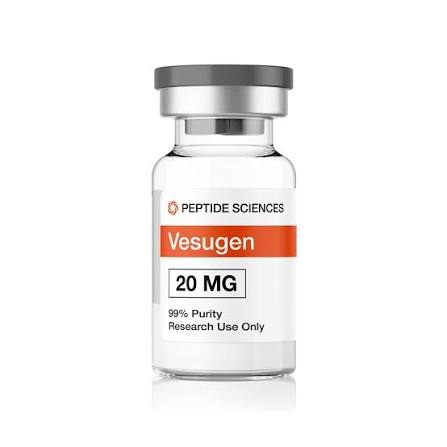
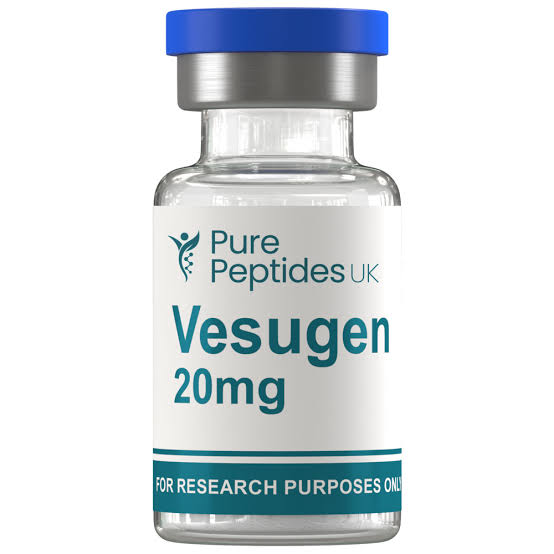
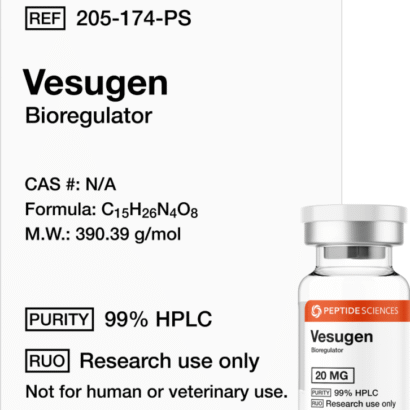
Vesugen Acetate normalizes blood vessel function by reducing peptide deficiency and restoring protein synthesis inside vascular cells. It supports endothelial cell function, improves blood vessel elasticity, and reduces the risk of cardiovascular conditions.
Price range: £72.00 through £700.00
Vesugen (T-38) is a synthetic tripeptide with the amino acid sequence Lys-Glu-Asp (KED). With a molecular formula of C₁₅H₂₆N₄O₈ and a molar mass of approximately 390 g/mol, this short regulatory peptide belongs to a class of bioregulators developed in Russia during the late 1990s and early 2000s, primarily at the St. Petersburg Institute of Bioregulation and Gerontology.
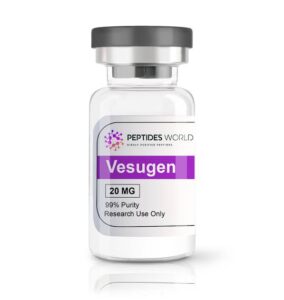
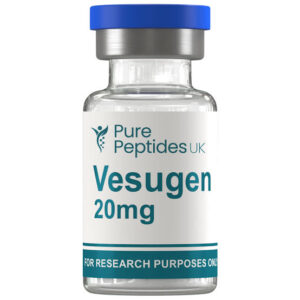
Vesugen is a synthetic tripeptide bioregulator with the amino acid sequence Lys-Glu-Asp (KED). Also designated T-38 within the Khavinson research program, it was developed at the Saint Petersburg Institute of Bioregulation and Gerontology by renowned scientist Vladimir Khavinson. With a molecular weight of approximately 390 Da and the formula C₁₅H₂₆N₄O₈, Vesugen represents a targeted approach to vascular and endothelial research.
Vesugen is proposed to function through direct epigenetic regulation. Unlike larger signaling molecules that act solely through extracellular receptor binding, this ultra-short peptide is hypothesized to penetrate cell and nuclear membranes to interact directly with DNA in gene promoter regions. Molecular docking studies have identified the MKI67 gene promoter as a specific target, influencing the expression of Ki-67 – a key cell proliferation marker that naturally declines with age in vascular endothelial cells.
Additionally, Vesugen has been reported to modulate SIRT1 expression, a longevity-associated protein involved in cellular stress response and metabolic regulation. In vitro studies also demonstrate its ability to normalize endothelin-1 (EDN1) expression, a potent vasoconstrictor peptide that is characteristically elevated in atherosclerotic conditions.
Vesugen is studied across multiple domains of vascular and cellular aging research:
· Vascular Aging Models – atherosclerosis progression, endothelial dysfunction, microcirculation impairment, and age-related vascular decline
· Cellular Aging Research – senescence marker expression (p16/p21), geroprotection mechanisms, and cellular proliferation capacity
· Neuroprotection Studies – Alzheimer’s disease models, neurodegenerative pathways, and synaptic plasticity mechanisms
· Epigenetic Research – DNA-peptide interactions, gene promoter regulation, and tissue-specific gene expression
Vesugen is available as a high-purity research-grade lyophilized powder, typically exceeding 99% purity verified by HPLC analysis. Liposomal formulations have also been developed to improve peptide stability, endothelial uptake, and targeted delivery to microvascular tissues.
Vesugen is not an FDA-approved drug and is not a prescription product in any Western jurisdiction. It is intended exclusively for in-vitro laboratory research conducted by qualified professionals. This product is not approved for human or veterinary use and should not be administered to humans or animals. All information provided is for educational and research purposes only.
Vesugen was developed from research on a natural peptide complex called “Ventfort®”, which was derived from the vascular tissues of young animals. Scientists identified the Lys-Glu-Asp tripeptide as a key active component responsible for the complex’s vascular regulatory activity and subsequently synthesized it in high purity. This tissue-specific origin gives Vesugen a natural affinity for vascular and connective tissues.
Gene Expression and Chromatin Modulation. Vesugen can bind specifically to DNA, modulating chromatin conformation and gene transcriptional activity. Research suggests it may bind to the promoter region of the MKI67 gene (which encodes the Ki-67 protein)—a well-established marker of cell proliferation—thereby epigenetically regulating its expression. This provides a molecular explanation for Vesugen’s vascular repair functions.
Endothelial Cell Regeneration. Vesugen Peptide promotes the proliferation and differentiation of vascular endothelial cells—the single layer of cells lining blood vessel walls. By stimulating the regeneration of these cells, it helps restore and maintain the structural integrity of blood vessels.
Angiogenesis and Microcirculation. In vitro experiments demonstrate that Vesugen exerts protective effects on vascular cells, improving microcirculation and enhancing vascular elasticity. It may enter the nucleus via peptide transporters (such as Pept1 and Lat1), activating cellular signaling cascades that promote the synthesis of vascular elastin.
Anti-Inflammatory and Antioxidant Effects. It can reduce the expression of inflammatory factors (such as CXCL12) and delay cellular senescence. It also improves tolerance to stressful conditions like hypoxia and reduces oxidative damage to neural and vascular cells.
Geroprotective Action. A PubMed-indexed study demonstrated that tissue-specifically stimulates the expression of differentiation factors in fibroblasts, with the inducing effect being more pronounced in aged cultures—suggesting a mechanism for its geroprotective (anti-aging) effects.
Vascular Health and Circulation. It normalizes blood vessel function by reducing peptide deficiency and restoring protein synthesis inside vascular cells. It supports endothelial cell function, improves blood vessel elasticity, and reduces the risk of cardiovascular conditions.
Microvascular Repair: As a short peptide bioregulator, it is purported to repair microvessels, improve blood flow, and support vascular elasticity, potentially counteracting early signs of vascular aging.
Cardiovascular Wellness: It is recommended for individuals with compromised blood circulation, particularly the elderly and those with vascular disease, microcirculatory disturbances, atherosclerosis, coronary heart disease, hypertension, encephalopathy, vegetative-vascular dystonia, hypercholesterolemia, or varicose veins.
Cellular Regeneration and Aging: Research indicates may influence stem cell behavior, promoting differentiation and tissue-specific repair processes. It has also been hypothesized to support mitochondrial integrity and metabolic regulation within cells.
It is available in multiple formats, including oral capsules (typically 60 capsules per container), injectable pen injectors (20mg/2ml), and liposomal formulations that improve peptide stability, endothelial uptake, and targeted delivery to microvascular tissues. Injectable administration is typically via subcutaneous injection for optimal absorption. It can be easily combined with other supplements and medications.
| Administration Form | Oral Capsules, Injectable |
|---|---|
| Quantity | 1 Vial 20mg-2ML, 2 Vials, 5 Vials, 10 Vials, A Box of 60 Capsules 20mg, 2 Boxs, 5 Boxs |